Biblical Theology of OT and NT by Childs Brevard S
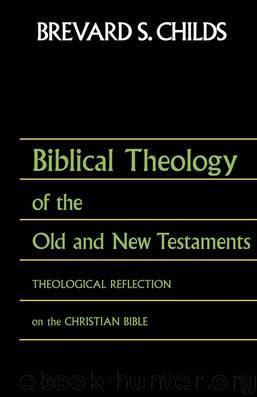
Author:Childs, Brevard S.
Language: eng
Format: epub
Publisher: Fortress Press
5. The Hermeneutical Function of Law Within Christian Scripture
There is a final topic to address which, although broader in scope than the subject of law and gospel, should serve as a summary of the chapter. How does Old Testament law function within the context of the Christian Bible?
In the history of the church a variety of answers have been proposed. The early church sought to read the Old Testament law largely typologically and to shift its semantic range entirely. Later on in mediaeval theology careful distinctions were made between moral law which was thought to retain its authority, and Old Testament ceremonial and juridical law which was judged to be obsolete for the Christian church (Thomas Aquinas, Summa la2a 98–105). Calvin argued that the law served chiefly to foster hope of salvation in Christ until his coming, which was a form of typological reading (Institutes, II. vii). Although Luther often made use of the church’s typological methods, he broke new ground in his bold formulation of a theological dialectic encompassing both testaments within law and gospel.
With the rise of the historical critical approach to scripture a new set of approaches were developed which often were adjustments to older views. In the nineteenth century, scholars such as de Wette and Wellhausen, sought to reconstruct Israel’s genuine history, but often assumed a Christian perspective in which the law slowly stifled Israel’s religious life until the law was transcended by Jesus’ ethic of love. More conservatively oriented scholars reacted by constructing a Heilsgeschichte which functioned independently of reconstructed history, but usually in the end resorted to traditional typology by which to interpret the role of Old Testament law (e.g. J. C. K. von Hofmann). Recently von Rad and Gese have attempted to reinterpret the role of Old Testament law in terms of a traditio-historical trajectory which culminated in the New Testament. Although I doubt seriously that any one attempt of the past has been fully successful in resolving completely the issue, this evaluation does not deny that important insights have emerged from this history of exegesis which must continue to be carefully considered in any new formulation.
First, I would argue that Old Testament law must be read in its historical context. (By ‘history’ I am including both the inner and outer dimensions discussed in some detail earlier, 3. I (1)). It is basic in understanding how Israel as a people and nation was shaped by its laws and conversely how its historical experience in turn shaped its formulation of law. A major concern would be to see the change and development in the function of law from the earliest period, through the period of the monarchy (e.g. Deuteronomy), to the exile and post-exilic era. It is also important to study the historical development through the post-Old Testament, Hellenistic period in order to determine how the Old Testament laws were heard and used in the historical period leading up to the rise of Christianity. The great theological significance of such a historical study is
Download
This site does not store any files on its server. We only index and link to content provided by other sites. Please contact the content providers to delete copyright contents if any and email us, we'll remove relevant links or contents immediately.
The Hatha Yoga Pradipika (Translated) by Svatmarama(3502)
Signature in the Cell: DNA and the Evidence for Intelligent Design by Stephen C. Meyer(3221)
Real Sex by Lauren F. Winner(3119)
The Holy Spirit by Billy Graham(3060)
The Gnostic Gospels by Pagels Elaine(2603)
Jesus by Paul Johnson(2452)
Devil, The by Almond Philip C(2430)
23:27 by H. L. Roberts(2310)
The Nativity by Geza Vermes(2281)
Chosen by God by R. C. Sproul(2239)
All Things New by John Eldredge(2228)
Angels by Billy Graham(2016)
Angels of God: The Bible, the Church and the Heavenly Hosts by Mike Aquilina(2010)
The Return of the Gods by Erich von Daniken(1991)
Knowing God by J.I. Packer(1929)
Jesus of Nazareth by Joseph Ratzinger(1878)
The Gnostic Gospel of St. Thomas by Tau Malachi(1865)
How To Be Born Again by Billy Graham(1848)
Evidence of the Afterlife by Jeffrey Long(1842)
